

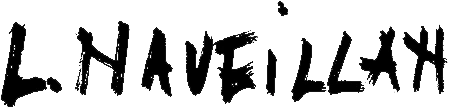
Lourdes Naveillán has lived in Talca for several years, where she even held a significant exhibition in November 2009 at the prestigious Art Gallery of the University of Talca. By then, her work had acquired a captivating density, emphasizing the freedom and expressiveness of her women in flowing headdresses and voluptuous skirts, who were beginning to break free from the strict norms of the court of Philip IV of Austria. Then, two months after the closing of that exhibition, the earthquake of February 27th struck. Much of Talca, like much of south-central Chile, collapsed, and life changed forever for those who lived to tell the tale. Lourdes Naveillán survived, not only physically and in her surroundings, but also in spirit. Although she grieved, and even titled her new exhibition at the La Sala gallery in Santiago “Between Times,” the vital instinct of her women prevailed over loss and pain, with the fortitude of those who accept that no one can predict our journey through this world.
Yes, Lourdes Naveillán’s paintings have taken on an unprecedented force. From the restrained drama of Infantas and Queens consort to the Habsburg King suggested by her early works, from those gestures that began to loosen the curls and elaborate farthingales we left behind in Talca, already glimpsing an imminent process of rebellion, today we have a celebration of liberated identities, of abrupt colors that demand our urgent incorporation into their rhythm and intensity because otherwise, they will simply leave us behind. The inveterate virtue of this artist is manifested in the fact that each of her stages has the completeness and assertiveness of its moment; Although they follow one another, none precedes or follows the other; they are complete in their purpose and outcome, like biographical instances of characters who one day appear before us, another day become intimate with us, the next day reflect in private, the following day shake off their acquired habits, and today depart, leaving like a whirlwind to wherever their horizon may take them.
Lourdes Naveillán’s painting process follows the pattern of her conceptual intentions. In a succession of counterpoints, intuitive gesture combines with the outline, dripping with the careful border, colorful improvisation with the restraint of black, just as the wood that raises reliefs combines with the digital process that multiplies the planes, or the pieces that hang on the wall with those that climb the walls. This multi-faceted intersection of the organic and the virtual, of the stain and the line, of the defined and the imponderable—far removed, of course, from any Manichean approach—finally blossoms into a work that is as direct as it is elusive, that simultaneously shocks and disturbs, stimulating and confusing, delighting and exacerbating. And all this to celebrate a new incarnation of these women of ancient lineage, whose flowing hair, slender waists, and billowing skirts are now immersed in the spiral of their liberated joy, toward which we see them depart, admiring them but unable to follow, for we have not yet learned how.
Or let us try: Why do two ladies in conspicuous attire become centrifugal circles that collide like galaxies? Why does a stain suddenly grow and expand in such a way that four, five, or more figures are absorbed until they become mere textures within it? Why, if there is now so much color, is there also so much black? Or: What happens when the artist pierces the thick paper of her paintings with the six acrylic screws that hold the plexiglass? What do the remaining pieces of wallpaper, torn and peeking out from the interstices of her flying figures cut from wood, signify? It is probably that Lourdes Naveillán is entering that space where mind, heart, and hand articulate in unison to execute her will. Or perhaps it is that Lourdes Naveillán is surrendering to expressive intuition, overflowing any structural reasoning and leaving the understanding of what she has created for later. It could be, in short, that Lourdes Naveillán has always been one of these multicolored silhouettes that now leap from the canvas and carry life before us.
Mario Fonseca
January 2011
“I is another,” wrote Arthur Rimbaud, and that otherness that is Lourdes Naveillan surfaces in the work she creates on canvas or paper with strokes of paint, the spilling of the ocean, or the dripping of stars, employing diverse tools from worlds far removed from the delicate craftsmanship of her creations. Color has always been the protagonist of her works, but gesture follows closely behind, almost nipping at its heels, as do textures, which can be voluminous or nearly transparent, surrendering to one another—swirling in the magic cauldron of the Master and Druid—in that language of as much eloquence as silence that the artist shapes.
Abstraction and figuration merge in that same tangle of meanings and signifiers, and it is no coincidence that her latest work is inspired by the mysteries of outer space, the cosmos that surrounds us, which she invokes when she immerses herself in her studio or ventures into the forests, fields, and mountains that have accompanied her for decades on her wanderings through life.
This artist dedicates herself entirely to the craft of painting, literally, using her torso, arms, hands, and legs—not just her head or instinct—to transfer matter and genius to her canvas. She works from bone and flesh, with spirit and mind, in her light-filled workshop, paraphrasing Rimbaud again, with his “Illuminations”; the same Rimbaud who once affirmed that “the poet must become a seer through the convulsion of the senses.”
Painting, precisely in its convulsive state, creates accidents that connect the sacred with the profane, guiding the stain and the movement, gestating the alchemy embodied in the works of Lourdes Naveillan, in which beings have gradually faded away. Today, the essence of her pictorial experience resides on the margins of the firmament, radicalizing her immersion in abstraction; however, it is not improbable that those indefinable beings, artifacts, or sculptures—raw poetry, pure creation made of scraps of glass, nails, iron, and wood—will soon emerge again from her studio, sooner rather than later.
In all these othernesses, the artist’s soul is reflected: the strength of her convictions, her boundless energy, and the crystalline clarity of a creator consistent with what she has brought forth, something that surprises and moves us. Because each new world is another world that she conceives and is born with her, viscerally united—another yet one, indissoluble—and her Universe is a constellation of nameless planets.
María de Lourdes Naveillan Goycolea (Santiago, 1971) channeled her early creative concerns through the pluralistic training offered by the Institute of Contemporary Art in Santiago and the Pontifical Catholic University of Chile. Later, she participated in the legendary workshops of Eugenio Dittborn, Arturo Duclos, and Taller 99. She has participated, both individually and collectively, in more than thirty exhibitions in Chile, Argentina, the United States, and France.
Marilú Ortiz de Rozas
PhD in Literature from the Sorbonne-Nouvelle University
Member of the Chilean section of the International Association of Art Critics (AICA)