

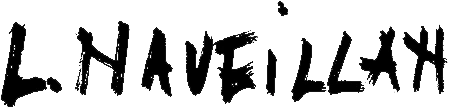
“I is another,” wrote Arthur Rimbaud, and that otherness that is Lourdes Naveillan surfaces in the work she creates on canvas or paper with strokes of paint, the spilling of the ocean, or the dripping of stars, employing diverse tools from worlds far removed from the delicate craftsmanship of her creations. Color has always been the protagonist of her works, but gesture follows closely behind, almost nipping at its heels, as do textures, which can be voluminous or nearly transparent, surrendering to one another—swirling in the magic cauldron of the Master and Druid—in that language of as much eloquence as silence that the artist shapes.
Abstraction and figuration merge in that same tangle of meanings and signifiers, and it is no coincidence that her latest work is inspired by the mysteries of outer space, the cosmos that surrounds us, which she invokes when she immerses herself in her studio or ventures into the forests, fields, and mountains that have accompanied her for decades on her wanderings through life.
This artist dedicates herself entirely to the craft of painting, literally, using her torso, arms, hands, and legs—not just her head or instinct—to transfer matter and genius to her canvas. She works from bone and flesh, with spirit and mind, in her light-filled workshop, paraphrasing Rimbaud again, with his “Illuminations”; the same Rimbaud who once affirmed that “the poet must become a seer through the convulsion of the senses.”
Painting, precisely in its convulsive state, creates accidents that connect the sacred with the profane, guiding the stain and the movement, gestating the alchemy embodied in the works of Lourdes Naveillan, in which beings have gradually faded away. Today, the essence of her pictorial experience resides on the margins of the firmament, radicalizing her immersion in abstraction; however, it is not improbable that those indefinable beings, artifacts, or sculptures—raw poetry, pure creation made of scraps of glass, nails, iron, and wood—will soon emerge again from her studio, sooner rather than later.
In all these othernesses, the artist’s soul is reflected: the strength of her convictions, her boundless energy, and the crystalline clarity of a creator consistent with what she has brought forth, something that surprises and moves us. Because each new world is another world that she conceives and is born with her, viscerally united—another yet one, indissoluble—and her Universe is a constellation of nameless planets.
María de Lourdes Naveillan Goycolea (Santiago, 1971) channeled her early creative concerns through the pluralistic training offered by the Institute of Contemporary Art in Santiago and the Pontifical Catholic University of Chile. Later, she participated in the legendary workshops of Eugenio Dittborn, Arturo Duclos, and Taller 99. She has participated, both individually and collectively, in more than thirty exhibitions in Chile, Argentina, the United States, and France.
Marilú Ortiz de Rozas
PhD in Literature from the Sorbonne-Nouvelle University
Member of the Chilean section of the International Association of Art Critics (AICA)